The Limitation of Stoicism
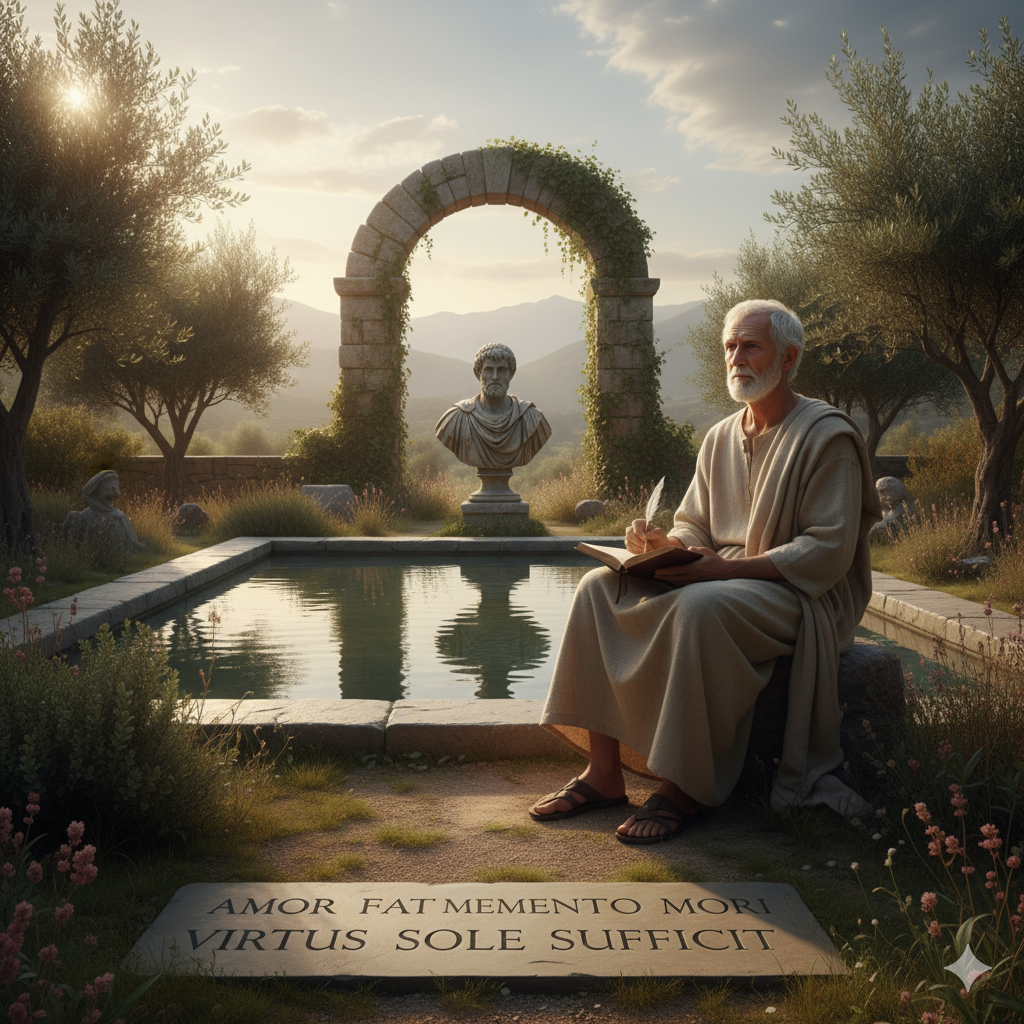
Stoicism is a product of privilege.
Not because it is wrong, but because it quietly assumes a set of conditions that are themselves luxuries: literacy, some margin of safety, the ability to choose. "Focus on what you can control" only makes sense if there is something left to control. Strip those conditions away and Stoicism doesn't become false — it becomes irrelevant, or worse, a tool that keeps the powerless in their place.
This is the Marxist and postcolonial critique of Stoicism, and the sharpest way to see it is through two characters Lu Xun created precisely to expose it: Kong Yiji (孔乙己), the failed scholar, and Ah Q (阿Q), the landless laborer.
The preconditions Stoicism hides
Precondition 1: basic survival security
Stoicism assumes you are not fighting for your next meal — that you have the slack to contemplate virtue instead of food.
- Kong Yiji doesn't know where his next meal is coming from. He steals books to sell them. He has no stable home.
- Ah Q is a farmhand with no land, one bad season away from starvation, no roof he can count on.
Maslow's hierarchy makes the point bluntly: when physiological needs are unmet, "self-actualization" is a joke. In hunger and fear, virtue is a thing you cannot afford.
The Stoic replies: "But Epictetus was a slave!" True — and instructive. His master was an intellectual who let him study. He was later freed. He had a community of philosophers. Kong Yiji and Ah Q had none of these.
Precondition 2: education and cognitive capacity
Stoicism requires you to grasp abstractions (the dichotomy of control), to practice metacognition (watching your own judgments), to sustain philosophical training over time.
- Kong Yiji has education — but failed education. He studied the imperial exams' eight-legged essays for status, not wisdom. When the exam system collapsed, his learning became a liability: too proud to do manual labor, too useless for intellectual work.
- Ah Q is illiterate, with no training in abstraction. His famous "spiritual victory method" is a pre-rational defense mechanism, not a philosophical choice.
You cannot ask an illiterate man to "rationally examine his judgments."
Precondition 3: room to choose
The Stoic core is "focus on what you can control." That presupposes there is something to control.
What can Kong Yiji control?
- ❌ The exam system (abolished — but too late for him to adapt)
- ❌ His social standing (already fallen)
- ❌ His livelihood (no skills, too old to learn)
- ❌ His body (his legs are broken)
- ✅ His attitude — but does changing his attitude let him live? No.
What can Ah Q control?
- ❌ The landlord's exploitation
- ❌ Being humiliated
- ❌ The revolution (which refuses to let him join)
- ❌ His execution (on a charge he never understands)
- ✅ His attitude — but that saves nothing.
For them, "control your attitude" is too little, too late. The inner world changes; the outer world still kills.
Precondition 4: social capital and support
Stoic practice needs a community that reminds and sustains, role models (Marcus Aurelius read Epictetus), texts to return to, and conversation.
- Kong Yiji has the mockery of the tavern, no friends, no community — and, ironically, his books get stolen.
- Ah Q has the whole village's rejection, no peers, not even a name of his own. Absolute isolation.
Isolation is the enemy of virtue. Without support, any philosophy collapses into self-deception (Ah Q) or despair (Kong Yiji).
Precondition 5: a minimum of social justice
Stoicism assumes society is basically rational — that practicing virtue won't leave you worse off, that you may suffer but won't be targeted for your virtue.
The world of Kong Yiji and Ah Q is the opposite: arbitrary violence, no legal recourse (Ah Q is executed on a false charge), no meritocracy (learning is worthless — Kong Yiji), structural injustice baked in. In such a society, virtue does not protect you — it can get you killed. Kong Yiji's scholar's dignity is exactly what stops him from bending down.
The Stoic says external justice doesn't matter, only inner virtue does. But when outer violence is extreme enough, when survival itself is at stake, "inner virtue" is not something you can eat.
The deeper problems
Is Stoicism an ideology?
The Marxist charge: Stoicism — like every "change yourself, not the world" philosophy — can function as a tool of the ruling class. It teaches the oppressed to accept things as they are. Don't change the world, change yourself. That serves the oppressor.
Kong Yiji and Ah Q prove it. Their inner adjustment never challenges the system; it makes them easier to exploit, and it even helps sustain the injustice — Ah Q bullies the weaker, Kong Yiji sneers at the "short-coats" below him. If everyone at the bottom practiced Stoicism — each cultivating inner peace, none resisting — you would have the perfect compliant subject. That is exactly what Lu Xun feared.
Inner citadel, or inner prison?
The Stoic "inner citadel" is meant to be a space of freedom the world cannot invade. But from another angle it is a retreat — a withdrawal into the self because you are powerless to change what is outside.
- Kong Yiji's archaic bookish speech: citadel or prison? He is trapped inside a useless identity.
- Ah Q's spiritual victory: inner peace or inner delusion? The gap between his inner world and reality only widens, until he dies without understanding why.
When inner and outer disconnect completely, the citadel becomes escapism — not strength but weakness, not freedom but another kind of unfreedom.
Virtue has a class character
Are the four cardinal virtues — wisdom, courage, justice, temperance — really universal?
- Wisdom needs education and time to think. Kong Yiji has a corrupted version; Ah Q has no access at all.
- Courage, for the Stoic, means facing death with dignity. What does it mean for a man with no choices?
- Justice means being fair to others — but when injustice has already crushed you, do you have the capacity to be just? Ah Q bullies the weak because it is the only power he can exert.
- Temperance means governing desire — but when your desires are survival needs (food, shelter, dignity), what is there to govern? Kong Yiji's wine is his one comfort.
Virtue requires material conditions.
"Accept what you cannot change" vs. resistance
The Stoic dichotomy: change what you can, accept what you can't. But in an oppressive society, what counts as "cannot change"?
The exam system was abolished. Landlord exploitation ended after revolution. Structural things that looked permanent turned out to be changeable — but only through collective action. Individually, Kong Yiji and Ah Q truly could change nothing. Collectively? Maybe. And Stoicism, by directing each person inward toward their own peace, quietly prevents that collective action.
This is the contrast between The Grapes of Wrath and The True Story of Ah Q: the Joad family moves from individual to collective and survives as a story of solidarity; Ah Q stays individual to the end, and so he fails.
Lu Xun's answer: neither Stoic nor revolutionary
Lu Xun saw through all the easy exits:
- Stoic "inner peace" is self-deception (Ah Q's spiritual victory).
- But revolution doesn't save Ah Q either — it rejects him, then kills him anyway.
- The intellectuals are hypocrites (the local gentry, the "fake foreign devil").
- The people cannot save themselves — uneducated, divided, without solidarity.
So what did he do? He wrote. He exposed. He dissected without offering a cure — "I have always been ready to think the worst of my countrymen." This is the lucidity of nihilism, not the comfort of Stoic peace. If he could speak to the Stoics, he might say:
Stoicism? That's the plaything of philosophers with full bellies. Kong Yiji tried it and became a joke. Ah Q tried it and became a tragedy. An inner citadel — in a place where you can't even keep your outer body? Change your attitude? Changing society is the real road. But who will change it? The intellectuals are accomplices. The people are Ah Q. So I write. I dissect. I offer no answer — because any answer, in this society, becomes a new deception.
The critique is correct
"In a society you cannot change, without education, without lofty moral or philosophical cultivation, Stoicism is empty talk — a city dweller's imagined, romanticized picture of the countryside."
This is exactly right. Stoicism is a privileged philosophy. Its preconditions are themselves privileges. Absent them, it either curdles into self-deception (Ah Q), becomes impossible to practice (Kong Yiji), or serves as the oppressor's ideology.
The "imagined countryside" is the key move. Urban intellectuals picture peasants who can practice virtue, find inner peace, transcend suffering. The reality is talking about virtue on an empty stomach, about inner peace while being exploited, about transcendence in the face of death. Lu Xun went and looked at the real bottom of society and found no noble peasant — only people being crushed, whose "philosophy" was pathetic rather than noble.
And notice the blind spot in the tradition itself: Marcus Aurelius was an emperor, Seneca was rich, and even Epictetus, though a slave, lived inside an intellectual household. None of them could see how a person with no education survives, how someone with no power maintains dignity, what "virtue" could possibly mean in absolute powerlessness. This is the flaw in every philosophy built "from above."
So what philosophy fits Kong Yiji and Ah Q?
Maybe none. The most honest answer is that no philosophy can help them, because the problem is not in their minds but in the structure. Philosophy changes minds; it does not change structures. That is Lu Xun's despair.
If anything comes close, it is not inner peace but its opposites:
- Liberation philosophy — Paulo Freire's Pedagogy of the Oppressed, Frantz Fanon's The Wretched of the Earth: not acceptance but awakening and resistance. Though this needs organizers, education, and hope — and where do those come from in despair?
- Survival pragmatism — not virtue but staying alive: how to protect yourself, how to find the crack in the system. This is the real wisdom of the bottom — not noble, but effective, and never found in books. Seen this way, Ah Q's spiritual victory isn't a philosophy at all but a coping mechanism that lets him survive a little longer. It deserves understanding, not mockery.
- Rage — the Grapes of Wrath mode: not inner peace but righteous anger channeled into collective action. Though in Ah Q's context, without any union or community, isolated rage curdles into lateral violence (Ah Q attacking the nun) or self-destruction.
What this means for you (and me)
Does this make philosophy useless? No. It means we have to understand its limits and its context.
If you are reading this, you have some measure of the privilege Kong Yiji and Ah Q lacked: education, time, resources, needs already met, a genuine choice in how to live. Which means Stoicism may well be useful to you — as long as you stay aware that this is because of your conditions, not because it is a universal truth.
For those with nothing, no philosophy will do the work of food, safety, dignity, and opportunity. That is not a failure of philosophy. It is a failure of society.
So the point of reading — of all this — is not to romanticize the bottom, and not to hand out a "philosophy for the poor." It is to see the privilege clearly, to see why changing the structure matters more than changing the mind, and then, maybe, to do something about it. Lu Xun wrote Kong Yiji and Ah Q so that readers who have the privilege would see. See, and then — he doesn't say. Maybe that part is our work to figure out.
Explore Further
Fiction (the case studies)
- Kong Yiji (孔乙己) and The True Story of Ah Q (阿Q正传) — Lu Xun. The two stories this essay is built on; short, devastating, widely available in translation.
- The Grapes of Wrath — John Steinbeck. The individual-to-collective arc that Ah Q never gets to make.
The Stoic sources (read them, then read the critique)
- Meditations — Marcus Aurelius. Stoicism from the throne — note who is writing.
- Discourses and Enchiridion — Epictetus. The former-slave's version, and the closest the tradition comes to speaking from below.
The critique
- Pedagogy of the Oppressed — Paulo Freire. Awakening and collective action instead of inner adjustment.
- The Wretched of the Earth — Frantz Fanon. The postcolonial account of powerlessness and what resistance costs.
- The German Ideology (esp. the sections on ideology) — Marx & Engels. The origin of the "ideology as the tool of the ruling class" argument used here.
- Motivation and Personality — Abraham Maslow. Where the hierarchy of needs comes from — why virtue presupposes survival.
Essays, talks & background
- Stanford Encyclopedia of Philosophy — Stoicism — rigorous overview of what the Stoics actually claimed.
- The School of Life / Alain de Botton, YouTube — accessible introductions to Stoicism and its limits.
- Massimo Pigliucci, How to Be a Stoic (book and blog) — a modern, thoughtful defender worth reading alongside the critique, so you argue against the strongest version.
The honest through-line: Stoicism is a real and useful discipline for those who can afford its preconditions — and recognizing exactly who can't is the whole point.